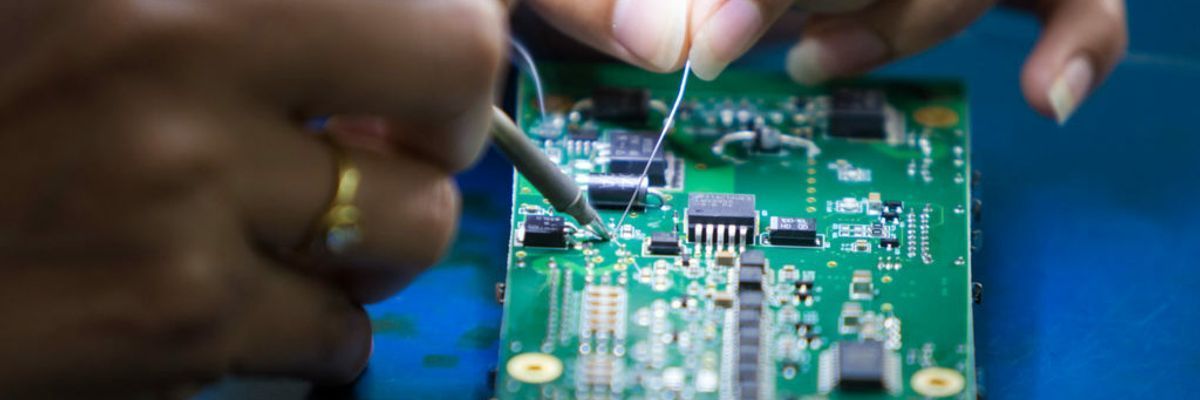
What is Manual Assembly?
Manual assembly in electronics is the process of mounting electronic components onto printed circuit boards (PCBs) or final devices, performed manually by an operator. It includes soldering components, wiring, quality control, and assembling complex or non-standard modules. Unlike automated processes, manual assembly allows for working with custom or low-volume products where the use of machinery is impractical or economically unfeasible.
Where and How Often is Manual Assembly Used in Modern Electronics?
Manual assembly remains indispensable in many areas of modern electronics. The main application areas include:
-
High-tech development and prototyping – at the stage of creating new devices when quick testing of design solutions is required.
-
Low-volume production – in cases where orders do not exceed a few hundred units, making automation economically unjustified.
-
Repair and modification of electronics – replacing parts or making changes to existing devices.
-
Military and aviation electronics – requiring special attention to quality and reliability, often needing manual control and refinement.
-
Medical equipment – some components require manual assembly due to high precision and special requirements.
Despite the rapid development of automation, manual assembly remains critically important for complex and high-stakes industries where human oversight plays a key role.
Will Robots Replace Humans in This Service, and Which Ones?
Automation is gradually being introduced into all areas of manufacturing, and the electronics industry is no exception. However, a complete replacement of humans in the "manual assembly" service is currently impossible due to several factors:
-
Flexibility and adaptability – humans can quickly adapt to new tasks, while robots require reprogramming and complex setup.
-
Quality and attention to detail – many high-tech devices require exceptionally precise assembly, which is still difficult to automate.
-
Working with unique materials and non-standard components – robots are efficient for mass production, but in low-volume or custom manufacturing, they still lag behind humans.
However, some technologies are already actively assisting in manual assembly:
-
Collaborative robots (cobots) – work alongside humans, facilitating precise and repetitive operations.
-
Automated soldering systems – allow operators to perform more complex tasks, reducing workload.
-
Machine vision and quality control – used for automatic inspection of manual assembly results.

Thus, in the coming decades, manual assembly will remain an essential part of manufacturing processes, although it will gradually be supplemented by robotic systems to improve efficiency and quality.